
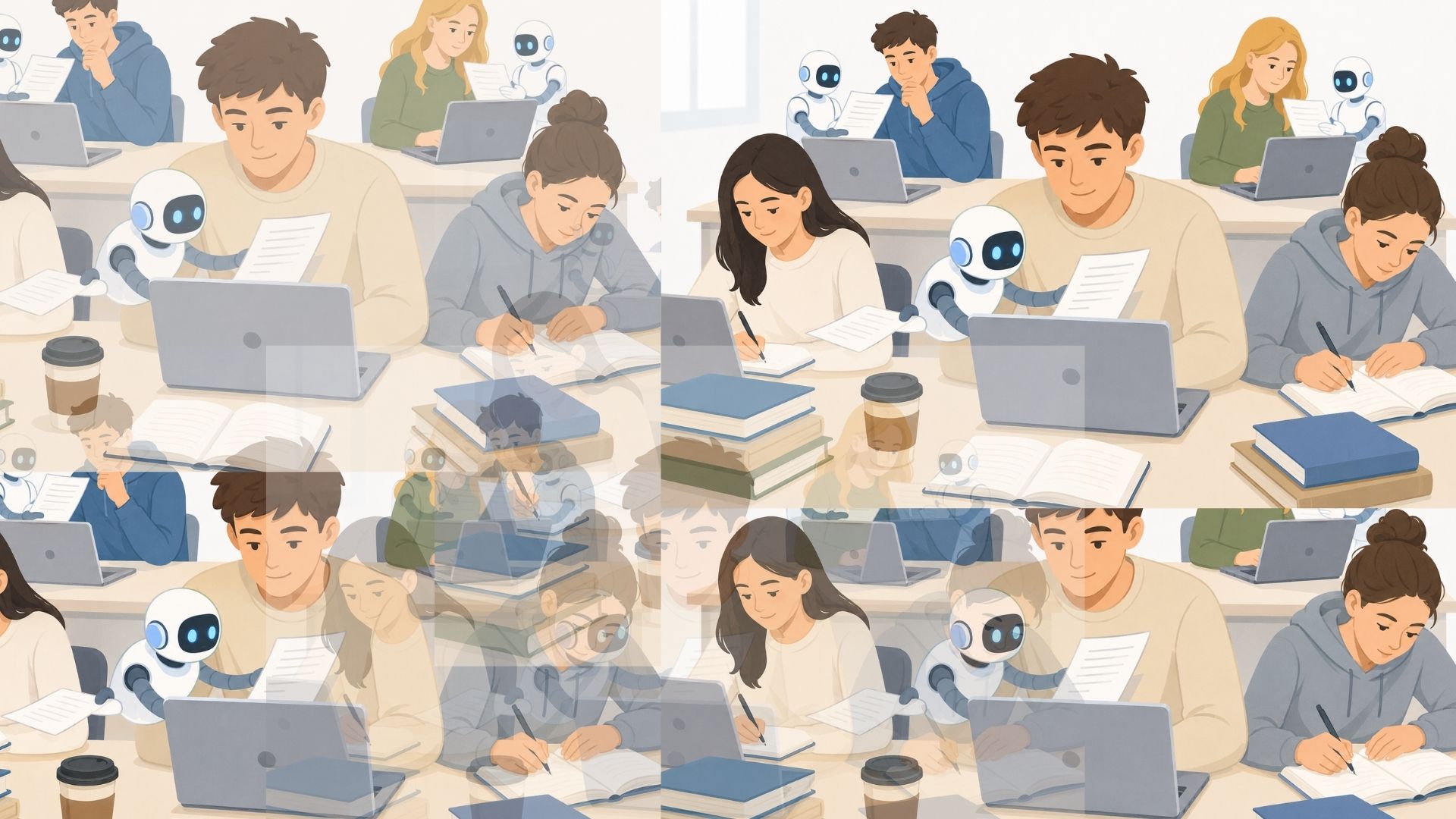
We need to teach students how to use it correctly
Does the term “AI” make you anxious? Do you feel that, in the near future, AI can or might replace you?
But hear me out. You are not alone in this. We all get that feeling that our degree may soon become worthless, and at times, we wonder whether what we’re doing even matters anymore.
These worries are real, but they are not the actual problem. They are symptoms of a problem that existed long before AI even appeared. And here is what matters: some of that anxiety is genuinely grounded in reality. The world is shifting. Everything will change in a certain way; everything is at risk. That’s not hype; it is just an observation.
The question is not whether you should be concerned. It is whether you are concerned about the right things. And honestly? Most of the conversation happening around you is pointing in the wrong direction.
The Question Everyone is Asking
Go to any college or university these days, and you will hear a common question: How do I stop AI misuse by students? Or how do I explain to my students how to use AI properly?
The question assumes that the AI user is a problem and that our current system is right. It is not that AI has created a crisis in education or work. It simply made visible a problem that was already there, just hiding.
What we have been measuring over the years
Over the years, educators have said they value critical thinking, original writing, strong understanding, and evaluative work. But while grading, it changes: it becomes about how polished your essay looks, how well you structure an answer, and how impressive the final work looks. So, we expect something that looks good to the eye. We have simply built the system on the appearance of the work, on the appearance of the learning and not on the appearance of understanding.
That was always a fragile model. AI just made the fragility impossible to ignore.
As the world changes, so does technology. Now the student can easily submit work that looks genuinely appealing in minutes using AI. It doesn’t prove understanding or any learning. It doesn’t prove original thinking. It proves that someone can arrange words in an academically acceptable way.
Which is… not the same thing at all.
This is why the anxiety about AI and cheating misses the real issue. It is not about how or why students cheat. It is that we built systems that reward performance over learning, and we have been comfortable with that arrangement for years. AI has made it impossible to keep ignoring it.
The real question is not “How do we catch people using AI?” It is “What were we actually measuring all along?”
Why Blaming Students Misses the Real Problem?
The conversation among educators becomes very moral and ethical. We talk about honesty, integrity, right and wrong. And those things do matter. But if we focus only on student behaviour, we miss the bigger problem.
Here is what is happening: students do not exist outside the system. They respond to the system they are in.
Think about it. You create a system where:
- One final submission carries most of the weight.
- That submission is what determines your grade.
- That submission can now be assembled in minutes using AI.
Obviously, the students will use AI to get the work done quickly, rather than learning how the work should be done. Now, this is not a moral failure. That does not always mean they are lazy or dishonest. Maybe it is a rational response to a system that rewards the finished product more than the thinking behind it.
And that is why the “cheating” conversation is so convenient. It allows schools, universities, and even workplaces to focus on catching misconduct rather than confronting a harder truth: many of our assessments were already rewarding performance over actual learning. We just didn’t have to face it until AI made it obvious.
The real problem is not that students are dishonest or lazy. The real problem is that over the years, we have built systems in which dishonesty becomes the logical choice.
What Needs to Change
The real crisis is not technological. It is educational. Teaching isn’t less important because of AI. It matters differently. In some ways, it matters even more.
And that means assessments need to change, too. We need tasks where thinking is visible, and shortcuts are less valuable. More staged work. More explanation of your process. More evaluative work. More authentic problems where you must show how you think, not just what you conclude.
And that means assessments need to change, too. We need tasks where thinking is visible, and shortcuts are less valuable. More staged work. More explanation of your process. More dialogue. More authentic problems where you have to show how you think, not just what you concluded.
You are not anxious about AI because AI is powerful. You are anxious because the systems you are working in were already fragile, and now everyone can see it.
The good news? That visibility is an opportunity.